Archive

Archive for the ‘WPF Controls’ Category

Microsoft WPF DataGrid vs. Commercial Solution: 1:0

December 30th, 2008

I’ve never been really happy with the commercial data grid I’ve been using so far - the whole API felt somewhat “winformish”, and required my to write a lot of XAML or even code for even the most basic tasks.

Today, I needed a simple grid on one of my current projects, and immediately got annoyed by the same issues that bug me every time. With the difference that this time, I had a new alternative to look at - Microsoft’s Data Grid that went V1 this October.

Well: This is an amazing control. It’s not amazingly powerful, it doesn’t have amazing animations, amazing views or anything like that. There is just one thing: It gets the job done.

Here’s my top 3 in comparison to my commercial product:

1: Data Binding

Finally I have data binding the way I always thought it should be. No more dealing with the internal data representation of the grid, and 2-way-data binding to selected items (not records or rows) out of the box. I didn’t even have to look up the API - it’s just as I expected it to be. Loving it:


<dg:DataGrid
  x:Name="platforms"
  ItemsSource="{Binding Path=Track.Platforms, ElementName=me}"
  SelectedItem="{Binding Path=ActivePlatform, ElementName=me}">

<!-- column definitions -->

</dg:DataGrid>


2: Liquid (Star-Sized) Columns

To my great surprise, I can easily star-size columns to take the full available horizontal space of the grid. This is a feature I need as good as every time I use a grid. With my commercial product, I was forced to write a whole layout template in order to get there. Not anymore:


<dg:DataGrid.Columns>
  <!-- fixed size column -->
  <dg:DataGridTextColumn
    Header="Name"
    Width="60"
    Binding="{Binding Path=ItemName}" />
  <!-- takes 2/3 of the remaining space -->
  <dg:DataGridTextColumn
    Header="Description"
    Width="2*"
    Binding="{Binding Path=Description}" />
  <!-- takes 1/3 of the remaining space -->
  <dg:DataGridTextColumn
    Header="Position"
    Width="*"
    Binding="{Binding Path=StartPosition}" />
</dg:DataGrid.Columns>


3: Styling

I really do like some of the carefully crafted themes of my commercial grid. But on the other hand, customizing it was a major pain, so styling was one of my main concerns. However, the MS grid is amazingly flexible and easy to use for a v1.0 solution.

In the end, I’m happier with my custom-styled result than the predefined theme of my commercial grid - simply because the custom style blends in perfectly with the rest of the UI:

styledgrid

checklist


Conclusion

I’m pretty sure that the commercial - and definitely more powerful - solutions have their rightful place on the market, but Microsoft’s grid really fills a gap for me here - especially because of the API that just keeps things simple.

I can’t help but think that the vendors that were the first ones on the market may be last in the long run. At least the API of the grid I used so far just doesn’t cut it for me. We all had to get (are still getting) acquainted to “thinking in WPF” and some of the “mature” solutions just give me the impression that their basic concepts have “Windows Forms” written all over them. And with regards to compatibility, it might get pretty hard to get rid of that. That is, however, just my 0.02$.

Go get it @ CodePlex: http://www.codeplex.com/wpf

Tags: ,

Organizing Heterogeneous Data on a WPF TreeView

December 11th, 2008

Most WPF TreeView samples you see on the web are somewhat simplistic: While they may provide heterogeneous data, usually all childs of a given node are of the same type:
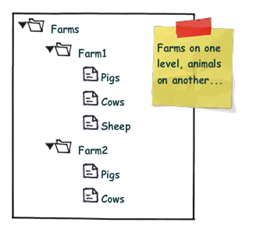
simpletree

However, more often than not, you’re running into more complex scenarios where additional structuring is necessary. Image your Farm class looks like this:
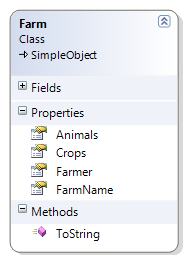
image

Accordingly, you might want to display that information according to the sketch below:
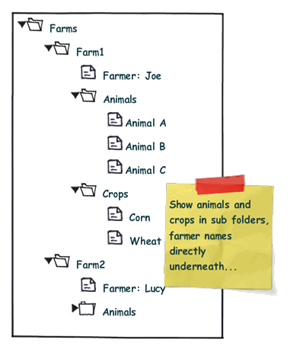
complextree

Note the difference: We want to organize the Animals and Crops collections within individual sub folders, while the "Farmer" node is a direct child of the "Farm" root node. From the control’s point of view, this means that the "Folder" nodes and the "Farmer" node are siblings.

Now, one solution to that very problem are ViewModel wrapper classes that optimize the business logic for your specific UI logic. This route does work very well for quite a few scenarios. However, sometimes, you just want to have a quick solution. I’ll try to provide one here…

My solution to that very problem requires the following ingredients:

  • A MultiBinding that allows you to combine different bindings.
  • A converter that helps us organizing the different bound collections into sub folders, where necessary.
  • And of course: Data templates that provide a visual representation of your bound data.


Let’s start with the bindings, which are declared within a HiearchicalDataTemplate. You can use a MultiBinding to retrieve all necessary data of a given Farm instance:


<HierarchicalDataTemplate DataType="{x:Type local:Farm}">

  <!-- bind the different data sources -->
  <HierarchicalDataTemplate.ItemsSource>
    <MultiBinding>
      <Binding Path="Farmer" />
      <Binding Path="Animals" />
      <Binding Path="Crops" />
    </MultiBinding>
  </HierarchicalDataTemplate.ItemsSource>

  <TextBlock Text="{Binding Path=FarmName}" />

</HierarchicalDataTemplate>


A MultiBinding always needs a converter of type IMultiValueConverter. Our converter has to provide the following functionality:

  • Allow binding of simple objects (Farmer), or collections (Animals, Crops).
  • Where necessary, put a bound child item or collection into a virtual container object that can serve as a "folder" when it comes to rendering.
  • Provide means to name (or even identify) a folder in order to simplify styling.
  • Render specific child items directly under the parent node (no subfolder). 
  • Return everything as a an object that can be bound to the TreeView.ItemsSource property.


I wrote a simple converter that performs these tasks. The initial declaration looks like this:

 
<MultiBinding Converter="{StaticResource folderConverter}">
  <Binding Path="Farmer" />
  <Binding Path="Animals" />
  <Binding Path="Crops" />
</MultiBinding>
 
…and it produces the following output:
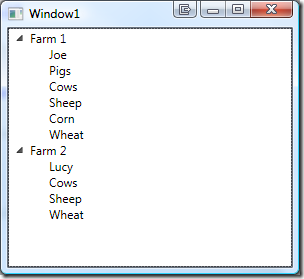
image


Obviously, the data is being parsed parsed and assigned to the "Farm" nodes, but we’re still lacking the desired structure (sub folders for animals and plants). However, this can easily be done by setting the ConverterParameter property:


<MultiBinding Converter="{StaticResource folderConverter}"
              ConverterParameter=", Animals, Cultivated Plants">
  <Binding Path="Farmer" />
  <Binding Path="Animals" />
  <Binding Path="Crops" />
</MultiBinding>
 

The converter parameter allows you to define folders for any of the items that are bound within the MultiBinding, while an empty string inserts a bound item directly under the root item. The converter parameter above produces the following output:

 image


The tree now renders the farmers and four FolderItem instances. FolderItem is a very simple helper class that is used by the converter to store the bound Animals and Crops collections. It provides just two properties:

  • Name (the string that was defined through the converter parameter)
  • Items (the folder’s contents)

Currently, the tree does not know yet how to render a FolderItem class, which is why there’s just the name displayed. What’s missing here is an additional data template for FolderItem:


<!-- data template for FolderItem instances -->
<HierarchicalDataTemplate DataType="{x:Type vm:FolderItem}"
                          ItemsSource="{Binding Path=Items}">

  <TextBlock Text="{Binding Path=Name}" />

</HierarchicalDataTemplate>


This finally produces our desired output:

image


Simply delegating data organization to the SimpleFolderConverter allows us to individually structure heterogeneous data for our TreeView control with a very simplistic approach. Below is the complete XAML for the sample:


<Window
  x:Class="Hardcodet.Farms.Window1"
  xmlns="http://schemas.microsoft.com/winfx/2006/xaml/presentation"
  xmlns:x="http://schemas.microsoft.com/winfx/2006/xaml"
  xmlns:vm="clr-namespace:Hardcodet.Farms.ViewModel"
  xmlns:local="clr-namespace:Hardcodet.Farms.Model"
  Title="Window1"
  Height="300"
  Width="300">

  <Window.Resources>
    <vm:SimpleFolderConverter x:Key="folderConverter" />

    <!-- data template for Farm instances -->
    <HierarchicalDataTemplate DataType="{x:Type local:Farm}">

      <!-- bind the different data sources -->
      <HierarchicalDataTemplate.ItemsSource>
        <MultiBinding Converter="{StaticResource folderConverter}"
                      ConverterParameter=", Animals, Cultivated Plants">
          <Binding Path="Farmer" />
          <Binding Path="Animals" />
          <Binding Path="Crops" />
        </MultiBinding>
      </HierarchicalDataTemplate.ItemsSource>

      <TextBlock Text="{Binding Path=FarmName}" />
    </HierarchicalDataTemplate>

    <!-- data template for FolderItem instances -->
    <HierarchicalDataTemplate DataType="{x:Type vm:FolderItem}"
                              ItemsSource="{Binding Path=Items}">
      <TextBlock Text="{Binding Path=Name}" />
    </HierarchicalDataTemplate>

  </Window.Resources>

  <!-- the treeview control -->
  <TreeView x:Name="farmsTree" />

</Window>


Of course, you can easily style any of the data templates to your liking. You find the complete sample under the link below. Enjoy :)

Download Sample Project (VS2008): farmtree.zip

Tags: ,

WPF TabControl transition effects with Transitionals

May 13th, 2008

Transitionals is a WPF framework that allows you to integrate nice transition effects into your WPF application with very little effort. It’s gone live a few days ago on CodePlex and definitely worth checking out:

http://www.codeplex.com/transitionals


I’ve downloaded the library today in order to incorporate a little eye candy into a prototype I’m doing. However, what I wanted to do was adding transition effects on a tab control, which is currently not supported out of the box by the framework:

Currently Transitionals ships with only two controls out of the box [...]. Other controls, like a Tab control for example, could also be created. We encourage the community to come up with other common navigation and presentation scenarios that can leverage transitions.

This sounded like a lot of work, but luckily, it wasn’t: TabControl provides a ContentTemplate property which can be bound to a data template. This is were I put a TransitionElement control and bound it to the current content of the tab control:

<DataTemplate x:Key="TabTemplate">
  <t:TransitionElement Content="{Binding}">
    <!-- some more stuff -->
  </t:TransitionElement>
</DataTemplate>

<!-- tab control with content template -->
<TabControl ContentTemplate="{StaticResource TabTemplate}" />


These bindings take care of everything - a tab switch changes the content of the TransitionElement, which triggers a transition animation. All that was left to do was configuring a transition effect and adding some content to the tab control. Here’s the complete listing that uses a 3D rotation effect:


<Grid>
  <Grid.Resources>

    <!-- the data template binds the content to a transition element -->
    <DataTemplate x:Key="TabTemplate">
      <t:TransitionElement Content="{Binding}">
        <!-- rotate tab contents -->
        <t:TransitionElement.Transition>
          <trans:RotateTransition Duration="0:0:1.500"
                                  Angle="90" />
        </t:TransitionElement.Transition>
      </t:TransitionElement>
    </DataTemplate>

  </Grid.Resources>

  <TabControl ContentTemplate="{StaticResource TabTemplate}">

    <TabItem Header="First">
      <!-- some content -->
    </TabItem>

    <TabItem Header="Second">
     <!-- some content -->
    </TabItem>

  </TabControl>

</Grid>


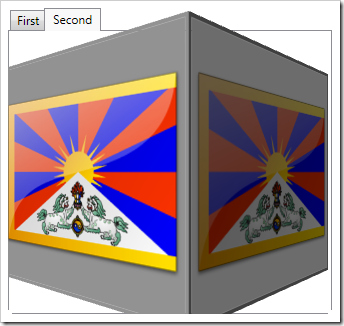
My sample contains two tabs which both display the same image. Accordingly, the code snippet above produces the following 3D effect when switching tabs:

transition

Tags: ,

WPF TreeView Update

April 7th, 2008

I’ve posted an update for my WPF TreeView which contains a bugfix and two new features:

  • The root item collection is now monitored for changes, and the tree updates itself automatically. This behaviour, however, can be controlled through the ObserveRootItems dependency property.
  • Built-in filtering support through a strongly typed predicate. I’m not completely happy with my implementation though - as a matter of fact, I’ve already started to rewrite it completely - you can expect the next version within the next 10 days. The filtering API however, will remain intact.

In case you did override some of the tree’s virtual methods, your project might not compile out of the box because some of these methods now receive additional parameters. However, as nothing has been removed, adjusting your code should be a matter of seconds.

I’ve added the download link to the original post:
http://www.hardcodet.net/2008/01/wpf-treeview

Happy coding :)

A WPF File Selection control

March 14th, 2008

 fileselector

This is a pretty simple user control, which allows you to display a file dialog to open or save files. Its look can be easily adjusted, and it provides built-in truncation of the file string to a predefined length if necessary. Here’s the XAML for the above sample control:

<files:FileSelector x:Name="openFileSelector"
                    Mode="Open"
                    MaxDisplayLength="50"
                    Height="24"
                    Width="400" />


The TextBlock in the screenshot which displays the full file path was simply bound to the control’s FileName dependency property:

<TextBlock Text="{Binding ElementName=openFileSelector, Path=FileName}" />


The control does not provide too many extension or styling points - the idea is that you just copy it into your solution, adjust the styling of the control’s contents (Border, Button etc.) and be on your way. The source comes with a small sample project - enjoy :)

Download Control

Tags: ,

New Blendables

March 6th, 2008

Just saw that Blendables have extended their portfolio of WPF controls. The stuff looks good, but unfortunately, their licensing scheme doesn’t:

A license is required for each machine utilizing the blendables controls. [...] As we do not offer a deactivation method, if you must reactivate on a new developer machine you are allowed up to 3 activations. This is for the case of re-imaging or setting up a new developer machine. Once this limit is reached you must contact blendables support at [...] to proceed with activation.

I must say, not purchasing their product is a no-brainer…

Tags: